
Ken Dryden’s Dilemma
The Hall of Fame Goalie was a College Baseball Star

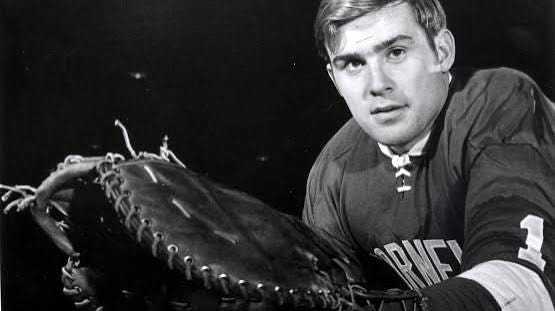
The aging grade-school librarian was wearing a familiar “C” on his ball cap. I had to ask.
“Did you attend Cornell?”
“I did.”
“Are you familiar with Ken Dryden?”
“He was a classmate.” My Spidey Senses spiked.
“Did you ever see him play at Lynah Rink?”
“No.” A buzzkill, but Kim the librarian continued. “I know that he played baseball as a freshman, and that he hit the longest home run in school history.”
Whoa! Ken Dryden as Roy Hobbs? The Hockey Hall-of-Fame goalie also in the pantheon of hardball sluggers? A bespectacled academic joining the ranks of the Bambino, Reggie Jackson and the Mick as sultans of swat? This needed further review. I rolled up my sleeves, ventured to the cliff’s edge, and dove down the rabbit hole.
Turns out it was another Ivy League slugger, Lou Gehrig of Columbia, who before joining the New York Yankees was the only man known to have hit the ball out of Cornells’s venerable Hoy Field. More heady company for Dryden, but this myth needed some hard evidence.
Enter Marshall Hain, devoted sports information director at Cornell, who provided a primary source—the end-of-season stat sheet from the 1966 Cornell frosh. Freshmen could not play varsity sports back in the day, so Dryden played both hockey and baseball his first year in Ithaca. Most of his diamond mates in ’66 went on to enjoy successful varsity careers.
Baseball stats are timeless: pitchers try to dominate batters and vice versa. Mano a Mano. Homers and strikeouts still go into the same statistical boxes, whether scribbled in by hand or typed into an Excel sheet. Dryden played in a mere 12 games in the spring of 1966, but his stats jump off the page: a .417 batting average, .511 on-base pct., OBS of 1.178. And penned innocuously into a little box, six rows the to the right of his name, were his two career home runs.
This essay was originally intended to capture the moment of Dryden’s lone Ruthian clout, but in fact there were two, each with its own story.
“He was the best athlete I ever knew,” said teammate Ken Soldewell. “He hit two home runs over 410 feet, one clearing the fence in dead center and disappearing into the abyss.” This account jibes with the librarian’s, a moonshot that evaporated into the ether. But there was another epic smash, this one two miles away.
Doug Roberts was a terrific hitter in his own right, an outfielder who batter .424 alongside Dryden, forming Cornells’ own Murderer’s Row in the middle of the Big Red batting order. “I’ll never forget get the game at Ithaca College,” Roberts said. “Ken hit a line drive over the temporary center field wire fence and struck a bulldozer which was situated there during the construction of the new campus. The ball ricocheted back into the playing field.”
There are no reports of sparks flying off the bulldozer a la Hobbs from the silver screen, but no one before or since has seen a homer rocket back onto the field off heavy machinery. There is no video of this smash, but the Homeric history lives on.
Most people interviewed for this story simply presumed the 6-foot-3 Dryden was a slugging corner infielder, a first baseman naturally, well-versed in defending with that big leather trapper of his. A goalie’s glove and a first basemen’s mitt are first cousins after all. To a scout’s eye, Dryden is the quintessential first baseman. The scouts are wrong.
Dryden was a shortstop at Cornell. Don’t rely on stereotypes, dust off the 60-year-old primary source. There in the second-to-last category of the stat sheet is the letter “A”, the digit that stands for assists. Dryden led the team with 39, his closest challenger had nine. Dryden spent half of each game in that 1966 season heaving the ball across the infield.
Getting a working mitt, however, was a bigger challenge for Dryden than throwing out runners. He showed up at his first practice nearly two weeks after his mates because of his hockey obligations. He arrived without a working glove, and that goaltending trapper of his was of no use. Dryden turned to team manager Jerry Kirzner without a moment to spare.
“I remember that he borrowed my baseball glove that season,” Kirzner wrote via email. “It was a large glove which I had broken in previously in high school. It fit Ken’s large hands, too. He took a liking to it,” Kirzner said. “I recall it being a ‘six-finger’ model with a deep pocket. The sixth finger served as the webbing in the glove, which, in turn, made it a pretty large one. Ken liked it and borrowed it.”
Dryden’s middle infield counterpart was second baseman Soldewel, who saw elite defense over his right shoulder every game. “One day, Dryden went into the hole and backhanded a ground ball and threw a laser to get the guy he had no chance to get,” Soldewel said, still in awe 60 years after the fact.
Dryden’s defense impressed others in Cornell’s baseball hierarchy. Jim Purcell was Cornell’s baseball captain in 1967, one of the Big Red’s premier pitchers of the decade. His junior year he recalled playing against Dryden.
“The only memory I have of him (Dryden) was toward the end of the 1966 season,” Purcell said. “We had the annual scrimmage with the freshman team—back then freshmen couldn’t play varsity ball. I just recall this huge shortstop who moved so well and with very good hands. I wished he had been my shortstop!”
The premise that Dryden filled out his freshman year playing baseball as a hobby holds no water. The idea that he was a merely a tall target to to throw to on defense is also patently false. Despite only a 13-game sample size (including the scrimmage), we can safely conclude that Dryden was a star in a sport that—in the 20th century at least—America claimed as its exclusive domain. Dryden was the only Canadian on on Cornell’s freshman roster of 1966. None of his peers had such combined excellence on both offense and defense. A 6-foot-3 shortstop with both range and ferocious power conjures up images of Major League superstars like Cal Ripken and Alex Rodriguez. The pre-law academic turned heads dominating a sport few hockey experts even knew he played. The talented Mr. Ripley had nothing on Ken Dryden, Esquire.
A thorough search reveals that Dryden came about his baseball prowess naturally—it was his passion. According to journalist Jeff Morris, Dryden was an avid card collector. “My friends and I loved sports, and we all collected cards,” Dryden told Morris. “I had more baseball cards and I was always a huge baseball fan. I have always loved the game for its aesthetic value.”
“I had a Virgil Trucks card,” Dryden told NHL.com “He had two no-hitters for the Detroit Tigers. His name was so interesting for a seven-year old. And there was Sibbi Sisti,” Dryden added, referring to the 1940s and ’50s utility infielder. “I thought that was a fantastic name, too.”
Dryden mentioned to Morris that he had a Mickey Mantle card which, at the time, was worth “probably more than a thousand dollars.” Morris surmised that Mantle was too mainstream for Dryden to get excited about.
The foremost chronicler of Montreal Canadiens’ history is Dave Stubbs, a journalist who developed a close relationship with Dryden based on mutual respect, although the star goalie proved to be an elusive subject, preferring not to discuss his exploits on ice. On Dryden’s 70th birthday, it was Stubbs who received a present from the reticent Hall of Famer.
“In my email was a photo of Dryden’s two feet, a baseball diamond stretching out beyond them,” Stubbs said. “He celebrated his 70th birthday in a minor-league ballpark, wonderfully off the beaten path.” Dryden’s relationship with baseball begs the question: What if? It was a question he pondered as an underclassman in Ithaca.
Baseball teammate Jim Piersanti treasures his abbreviated diamond journey with the legend. Piersanti made a point of returning to campus in 2017 for the 50th anniversary of Cornell hockey’s 1967 national championship. “I had no idea he would be there,” Piersanti said, but he decided to go anyway, just in case his hero made an appearance.
“And there he was, facing the longest line of autograph seekers of any of the players,” Piersanti said. “I went and stood in line. I didn’t expect Ken to recognize me. It had been 50 years since our last contact.”
Piersanti waited patiently, and when he was second in line, the woman in front of him exploited her opportunity and got several autographs from the celebrity. “She started digging into her pocketbook, pulling out every piece of paper she could find to get him to sign,” Piersanti said, who observed Dryden being exceedingly polite as he accommodated each request. Growing impatient, Piersanti took action.
“I got to the point where I said to the woman: Lady, do you realize that you are getting the autograph of the best shortstop Cornell ever had?”
Dryden immediately looked up from his chore. “Holy smokes! Jim!”
“He recognized me and I couldn’t believe it,” Piersanti said. Dryden proceeded to reel off half a dozen names from their 1966 team, basking in the memories of his beloved ball club, despite being at a hockey reunion. “It was fascinating that he would remember all those baseball players,” Piersanti said. Dryden’s next comment left Piersanti speechless.
“He said that he had such a good time playing baseball, that it was really a 50-50 decision as to whether or not he was going to the hockey team or continue his baseball career.”
“It blew me away,” Piersanti said, who then recalled his exact response to Dryden back at the 2017 hockey reunion. “My god, you certainly made the right decision.”
The question remains: What if?
Great read Rapper. As a former goalie and ball player, I could relate. Of course not on the planet as Ken Dryden was.
Great job, as always sir.